
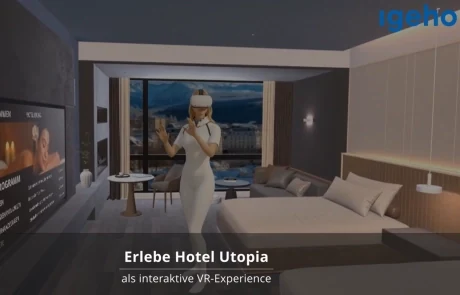
VR, AR, MR, XR – an alphabet soup that confuses more than it explains. Yet at its core, the difference is quite simple. It all comes down to a single question: how much of the real world can you still see?
Virtual reality: the world disappears
In virtual reality (VR), you put on a headset – and the real world is gone. You’re standing entirely within an artificial environment, free to look around, move and interact with it. VR is the deepest plunge: maximum presence, maximum immersion. The price is that you can no longer see your real surroundings – freedom of movement requires a secured space.
Ideal for: walk-in experience worlds, simulations of dangerous situations, journeys to places that don’t exist or are out of reach.
Mixed reality: both worlds at once
In mixed reality (MR), your real surroundings remain visible through the passthrough cameras. Virtual objects are blended in and anchored in the space. You see your own hands, your table, the person next to you – and in between, the virtual content floats or stands. That’s exactly why in MR you can operate real, physical objects while the effect happens virtually.
Ideal for: product demos with real controls, training on the actual object, trade fair experiences that several people share at once.
And what about AR and XR?
AR (augmented reality) usually means simple overlays on the real world – often on a smartphone, such as a piece of furniture projected into your living room via the camera. XR (extended reality) is simply the umbrella term for all of them: VR, AR and MR. MR is considered the most sophisticated form, because real and virtual are not just layered on top of each other but interlinked.
The decision in one sentence
Should the user be somewhere else entirely? Then VR. Should they be here, doing something real? Then mixed reality.
In practice, the question is rarely “technology X or Y” but “what should people experience and do?” We always start from the goal and then choose the tool – not the other way round. Sometimes it’s VR, sometimes MR, sometimes a combination. For an overview, visit our page on Mixed Reality Experiences.